

A virtual film « adda », a chat, that took place a couple of years ago via email with two of my favourite human beings: Anuraadha Tewari and Amrit Gangar
« Cinema is dead ! », this is what the whatsapp status of a Calcutta based film maker reads. I am sometimes terrified to such an unabashed admission. Eventhough I am not a serious stakeholder of cinema, five years ago, I felt the need to understand from within the mind of a film maker. How do they think? How do they write? How do they remain focused? how do they negotiate? Can they be unbiased? I had all sorts of stupid questions popping up from here and there. Unanswered, most of my questions were, therefore, I preferred to focus on defining the trendlines and following the trajectories of India’s « world cinema ». It was pretentious and I was wrong. I should have, instead, tried to create a balance between the thought process of a Cinéaste and how do they want to pave the way for new ideals with an effective outcome. Better late than never!
I was too much involved in understanding film finance, film economy, coproduction mechanisms, cultural diplomacy, I mean, all sorts of big words which could give impetus to the perspectives of Indian cinema and make it smarter than ever in the world. Or, the large part of the real stakeholders of cinema back home were stuck in fixed and outdated ideologies! Perhaps, hackneyed. « Noone reads books these days and, in fact, we lack good books on cinema », very often this is what I get to hear from the film veterans of India. And that is why I always feel the necessity to document what they have to say about world cinema in general and Indian cinema in particular. I must connect.
When morality is at issue, art loses it autonomy, this is what the contemporary ethical thinking shows us today. How are the questions of the good and the just trying to be formulated in a new way at a time when we can no longer resort to immutable and transcendent moral values? Is Cinema really dead? I don’t think so. Even if I am trying not to intellectualise this write-up, I must refer to what Sartre had said in the middle of the 20th century in his book « L’Existentialisme est un humanisme », « No general morality can tell us what to do: there is no sign in the world. »
We are either condemned or blessed to invent our existence through moving images and so the values we wish to follow. The term ethics, which is largely missing from the cultural discourse in India, is distinguished from that of morality in the sense that morality refers more to a structure made up of norms whereas ethics implies a questioning on the norm itself.
Ethics questions the foundations of these norms and at the same time confronts the absence of immutable moral criteria. If the contemporary world of Indian cinema needs to think of an ethic, it is precisely confronted with a vacuum from the point of view of moral value.
How can we be accountable for our actions when we can no longer content ourselves with showing adherence to a superior body that knows what to do in our place? We resist. We look for a greater aesthetic justice.
Therefore, I thought of documenting the thought process of Amrit, Filmosopher and the Creator of the concept « Cinema of Prayōga » who I met couple of years ago in Paris and of Anuraadha, accomplished screenwriter, my flatmate in Cannes during the festival which got over a couple of weeks back. She tells us about the wheels of Dharma, Yin and Yang which are probably transforming the contemporary film thinking in India.
Writtwik : Can you tell us something about your vision regarding the Indian cinema ?
Amrit : With its massive size in number both in terms of films produced and the number of people employed as also the investment made year after year, the Indian cinema to me is a beautiful multi-legged octopus. Deeply and continually drawing from the Indian epics and the Natya Shastra, the ancient text on performing arts and aesthetics, it, unlike in the West, defies genrefication, the cut-and-dried categorization. It seamlessly mixes rasas, the exalted sentiments or juices of tastes that counter the Western aesthetics of the genre, including cinematography.
As the Natyashastra broadly defines, Rasa is produced from a combination of Determinants (vibhāva), Consequents (anubhāva) and Transitory States (vyabhichāribhāva). It is indeed a complex system of aesthetic experience that India has developed over centuries and I would personally like to integrate this experience with the film theory, film studies for enrichment. And there are so many philosophical, semi- or para-philosophical thoughts and concepts that could be ploughed back into film scholarship and historical perception, maybe beyond the so-called ‘rationalism’. This approach would also lead us to an embracement of polyphonic and non-hierarchical reception of Indian cinema.
Writtwik : Evolution of world cinema in general and specifically the evolution of Indian cinema, where are we heading to?
Anuraadha : I think for starters the two are like galaxies, moving away at a very rapid pace from each other! Having said that, I think the mandate of World Cinema in general and Indian Cinema in particular are poles apart. While the former is dedicated to the Art of Storytelling and evolving and pushing boundaries with each successive year, Indian Cinema is designed and expected to fill up emoty lives with hope, make the struggle of the underdog look worthwhile, to sell dreams and aspirations to a third world nation. Its mandate is far away from Art. Of course, its focus is also the commercial, but frankly that was the mood at Cannes as well. Not one Buyer at the Producers’ Network spoke of the Art House or Arty kind of Cinema. Everyone wanted that which sells, that which will get the audience in. India simply has slightly distinct reasons for the audience to be drawn in, for Cinema to sell. The principles of the business are, the same. It’s all a high-stake business first.
Writtwik : Can you tell us something about your experience at the festival? What are the Cannes take aways?
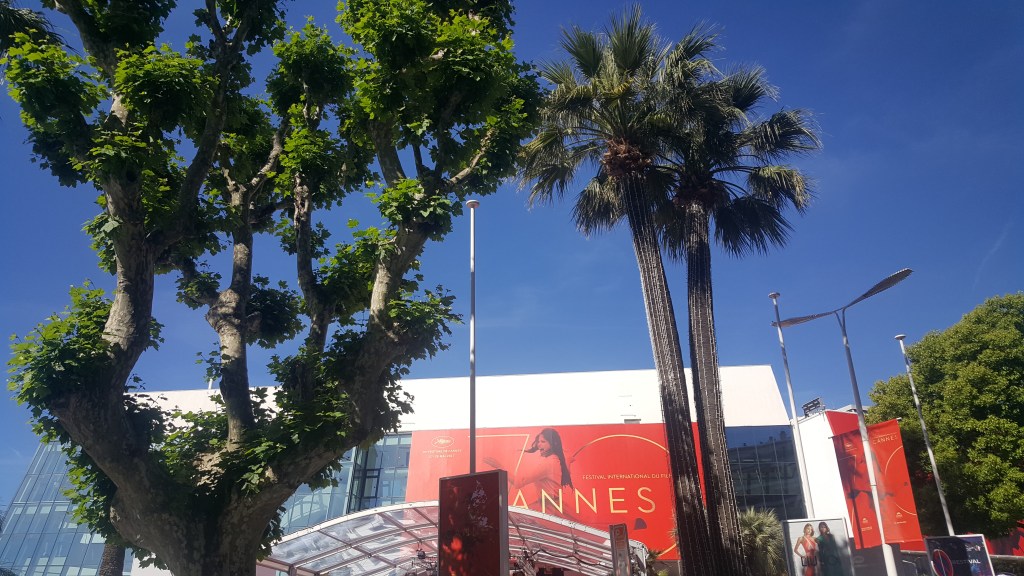
Anuraadha: This was my first visit to Cannes as well as the festival, though Ive been to France many times. It was really a mixed set of emotions. In some ways, it felt much smaller than I imagined. The famed Red Carpet for example was no bigger than say the ones they put at PVR Cinemas for regular Bollywood Premiers. Yet, scale apart, the sheer fact that you are mingling with the Best in Cinema from around the world is a heady feeling that very few other expreinces can rival. To be at a Master Class with Clint Eastwood or to exchange notes with Pedro Almodovar . . . it’s like a spiritual jouney . . . a Pilgrimage of Cinema as it were. The biggest take away, however, has been the nurturing, maternal energy of the festival. I think, Cannes is Feminine. It encourages you, exhalts you, lets you discover and yet supports in small, amazing ways . . . almost whispering in your ears . . . “Go make a Good Film! Go!!!” I think, that is most moving thing about this experience.
Writtwik : What is « Cinemas of Prayoga » and are they different from Genre films? Are « Cinemas of Prayoga », transgressive in nature? (The question is perhaps stupid! please excuse!)
Amrit« Cinema of Prayōga » is a conceptual framework that locates the history of experimental film in India within an ancient pre-modern tradition of innovation, of prayōga. Cinema of Prayōga is a theory of filmic practice, which challenges the dominant forms of filmic expression in contemporary India, including the all-pervading contemporary Bollywood or the social realism of Indian New Wave.
« Cinema of Prayōga » celebrates a cinematographic idiom that is deeply located in the polyphony of Indian philosophy and cultural imagination. It attempts to reconfigure the « generally » accepted notion of the experimental and the avant-garde in Indian cinema by conjuring the term ‘Prayōga’ from Indian philosophical thought. Etymologically, the term prayōga in Sanskrit refers to a theory of practice that emphasizes the potential of any form of contemplation – ritualistic, poetic, mystic, aesthetic, magical, mythical, physical, or alchemical. In cinema, it is a practice of filmic interrogation that is devised as a quest toward a continuing process in time and space.
No, « Cinema of Prayōga » is not transgressive in nature in its literal or whatever sense, it has no fascination to break rules as the word would obviously claim on the contrary Cinema of Prayoga would aim at deepening and intensifying the aesthetic-spiritual experience through cinematography by evoking a temporal anubhooti, a deeper experience. It would treat cinematography as a temporal art rather than a visual, and this is significant, as it inherently gets closer to kāvya (poesy) or samgeet (music), their temporal and experiential abstraction, freeing itself from being representational.
In its filmosophical essence, « Cinema of Prayōga » avoids employment of the Western terms such as experiment, genre or avant-garde. Avant-garde is at its roots, a military term, no matter it has been part of art vocabulary all over the world and for a long time now, the idea of ‘genre’ seems to be departmetmental-storish, pigeon-holing.

Writtwik : As the ideas of pluralism are being challenged by rising populism and xenophobia, how do you see the concept of « Desh » (Nation)?
Amrit : History keeps unclothing the truth, turning it naked all the time, peeling off its skin, and throwing it up right in our face. The Mantra of Multiculturalism that the West had begun to chant in the 1970s and later was embedded, I am afraid, in skepticism and selfishness. They, then needed, labor, and cheaper labor from the East, or maybe there was a sense of cleansing the guilt of colonizing many counties of the East, and as the generations passed, from the first to the third, uncomfortable truth kept unraveling itself, the economic and racial realities started popping up their heads. It kept becoming an uneasy situation with the blooming diasporas and deeper economic and racial contradictions dancing their sporadic dreadful dance!
The polyphonic voices started to become uniphonic, judgmental, racial and intolerantly nationalistic on the octave of history. This octave is not always upward moving, it has its ups and downs, while chasing the utopia of equilibrium. We are all in search of this utopia to counter xenophobia, which history has witnessed over centuries, through rising populism and existential angst. It is an ongoing battle between the good and the evil through ‘samaya’, time.
What is interesting is the process that history undergoes through human interventions, and the way it keeps creating power-centres, while at the same time, making humanity more and more fragile, the search for ‘détente’ is a sign of insecurity and the fear of collective annihilation. On the wobbling project of ‘multi-culturalism’ was foisted the so-called project of ‘globalization’, a fake, trade-globalization that has not been able to unify the world or tempering its intolerance. Why have you to ask me this question of ‘rising populism and xenophobia’ in this age of globalization? The question per se suspects the idea of globalization as it is, or contradicts it.
I think the Classical Globalization, if I may call it so, was more culturally healthy, I am referring to knowledge exchange and human movements and not ignoring the facts of oppression and persecutions. The continental-sized India with her polyphonic voices of religion and language had always kept the doors of her house open, where many philosophers and artists (including film makers) would come, settle and contribute their skills and visions. And here perhaps the emotively embedded notion or concept of ‘Desh’ becomes crucial. Even today, if a migrant from a village now settled in the metropolis of Mumbai, while going to his native place or village would say that he is going to his ‘desh’. Desh would also mean ‘nation’, e.g. Bharatdesh or even Bangladesh. ‘Desh’ or ‘Des’ as a micro-term includes the ‘micro’, imagine, a ‘village’ wombing a « nation »! It is so inclusive.
Desh or Des is an interesting notional or emotional term that most Indians largely from villages often use. In this sense, the idea of ‘rashtra’ (nation and therefore nationalism) is perhaps an imposition, maybe an import from the West. I think, our fellow-villagers were or are more progressive and modern in their perception of humanity and the world at large. India is a great federation of the smaller units called ‘desh’ and that’s her strength – in her polyphony, her pluralism, her heterogeneity ; she is obviously not a single monolith, and yet wields a strength of her own in nouising myriad and multiple views…
And no wonder we keep hearing this song from a remote Rajasthani village : Kesariya balam / Padharo mhare des – it acquires a new meaning in our times of ‘globalization; this ‘des’, as a country, a rashtra, where, in fact, are many rashtras, many des or desh.
In Sanskrit language, the word ‘Desh’ has some interesting connotations too, e.g. it also means ‘atithi’, a guest who comes to your home without any prior appointment or date (tithi) and he is still most welcome because he is not only your guest but god, as the saying goes, « Atithi devo bhava »: This is a traditional Indian ethos. Atithi is also a foreigner, a desh-atithi. Desh is a region, province or a country as a whole. I think, in its deeper essence, it obliterates the notion of a nation in its narrow nationalistic sense.
Anuraadha : Well, if you’re asking me from a Political perspective then the concept of a Nation is a necessary evil. The Human Mind understands order through segregation and needs a sense of belonging to feel safe. A Nation gives you all that and more. From the perspective of Cinema, it can be a boon and a bane. There are Films bind the Nation intangibly as a whole and give you that indescribable feeling of being One in this strange way and then there are times when a National Identity and its collective sensibility can be restrictive and a pejorative when represented outside . . . like the term ‘Indian Cinema’ on a global platform often is.
Writtwik : As a film professional, do you think the world of cinema both in India and in France or in Europe is equipped to deal with multiple systems of knowledge in order to reinvigorate the idea of pluralism in an era of post truth? What can India bring to the global debate on a world without borders?
Anuraadha : I am not sure what exactly you are implying with the first part of your question. Of what I understand, in India, ‘truth’ is a multi-angled phenomenon, a bit like ‘Rashomon’, but it’s also embraced in its plurality. I think the European mindset while not accepting of multiple truths isnt exactly honest about the chosen version! I think, that reflects in the both the Cinemas at multiple levels.
On the global debate on a world without borders, I think, India is virtually the pioneer of this thought since ancient times! We have been a Nation despite principalities and kingdoms for the longest time. We continue being a Nation despite the overwhelming diversity of culture in all its forms and nuances. I think the very existence of the Indian Polity. Polity proves that it’s possible to be connected despite inherent and intense differences and that borders are merely political necessities and forms of governance . . . . there is a way to feel the unity. Indian Cinema does a stupendous job of giving us that feeling every once in a while. Art notwithstanding.
Amrit : The present globalization has made the monster of market more monstrous and that is swallowing all creative, independent, intrepid voices though it creates an illusion of democracy and universal empowerment. it is not beyond suspicion as new monopolistic powers tend to control our world.
It has given birth to big and bigger fish that keeps gulping all the smaller fish. In India, we see the disappearance of those charmingly raw B and C grade films, those small producers have been pushed out of the scene, and technology has not made the so-called mainstream film making cheaper, it is all in the neo-capitalistic game, which has cleverly formulated its own norms for the rich and the powerful.
Films with massive publicity budgets can capture the maximum multiplex screens, not allowing the smaller fishes to swim in those waters. It is a new territorialism that has been created in this age of illusionary globalism. Cinema of Prayoga and its practitioners are essentially makers of antithesis to the monster of marketism.
With her historic intellectual-philosophical traditions France, and India, with her, emotional-philosophical historicity can resist these anti-art neo-capitalistic, even crony-capitalistic forces. And in this sense, I would believe that France and India are inherently equipped to deal with multiple systems of knowledge in order to reinvigorate the idea of pluralism in an era of post-truth as you said though I have a problem with this term ‘post-truth’ it will keep shifting as ‘post’ in ‘modernism’. Like modernism, truth is also in continuum as Indian mind would think.
The world without borders is perhaps not the same as Friedrich Engels had imagined within Marxiam philosophy, the withering away of the state. His imagination was beautiful as he said, “The interference of the state power in social relations becomes superfluous in one sphere after another, and then ceases of itself. The government of persons is replaced by the administration of things and the direction of the processes of production. The state is not « abolished », it withers away.”
The centuries-old Indian Maha Upanishad has this perception of the world : “Vasudhaiva kutumbakam”, which means the world is one family. Won’t you call it the modern ? With such ancient wisdom that is also practiced at large by her citizens, India can certainly contribute and bring about a global debate around the perception of the governable globe without walls, without boundaries, without divisions.
But personally, I would think these are necessary utopias, the utopias that we must keep chasing, we cannot live without this process… France, as a European, rational, intellectual ‘desh’ can create an environment that can groove into the Indian emotional-intellectual ethos with its tattva-jnana (knowledge of truth, of essence).
Writtwik : When morality is at issue, art loses it’s autonomy. What, according to you, should be the role of public intellectuals in the time of crisis?
Anuraadha : Frankly, according to me, Art has been slowly losing its autonomy over the last few decades as Commerce has taken centrestage. Its the victory of the Masculine principle over the Feminine in this one. Im also a believer of the wheel of Dharma, in motion constantly, and that the Yin and Yang of the world will keep taking turns in different spheres. In Cinema it’s the Yang taking over for now but the Yin will also return sooner than later. Hence the job of a Public Intellectual in my opinion is to neither resist nor protest unduly but to simply keep the Art alive and thriving till it makes its come back on centre stage.

Amrit Gangar is a Mumbai-based poet, writer, curator, historian and cultural activist. He is curatorially engaged in the upcoming National Museum of Indian Cinema.
Anuraadha Tewari is Mumbai-based screenwriter and film maker with a degree in Mass Communication with a specialization in Film Direction. She has written films like « Jail », « Fashion » and « Heroine »
Reference:
L’Existentialisme est un humanisme, Paris, Editions Nagel, 1972, p.47
En savoir plus sur Serendipity
Abonnez-vous pour recevoir les derniers articles par e-mail.

 Serendipity